
How to Exfoliate Before a Spray Tan: What the Technician Can’t Fix for You
Exfoliating for a spray tan is not the same as exfoliating for a self-tanner at home. At the salon, the technician sprays the same formula across your entire body at the same concentration. There is no adjusting for a rough patch on your elbow or a residue-heavy zone on your shin. Whatever surface condition you walk in with is what the solution develops on. What you do the night before determines what you leave with.
Why exfoliating for a spray tan is different from self-tan at home
When you apply self-tanner at home, you control the amount and can blend more carefully around problem zones. Salon spray tan works differently. Professional formulas tend to be more concentrated than most at-home products, and the technician applies them in a single uniform pass. Uneven skin texture does not get a second look.
The active ingredient is DHA (dihydroxyacetone), a compound that reacts with amino acids in the outermost skin layer to produce a brown pigment. It reacts wherever it lands. Rough, layered skin has more surface area in those zones, so DHA develops more intensely there. That is why dry elbows go noticeably darker than the rest of the arm. More texture, more color grab.
At home, you catch that and blend more. In the salon, the technician has moved on. Getting your skin surface right before you arrive is the only variable you control.
When to exfoliate before a spray tan
The right window is 24 to 48 hours before your appointment. The night before is standard and works for most people. The morning of is not ideal: freshly worked skin needs time to settle, and scrubbing too close to the session can change how the surface receives the formula.
Going further than 48 hours out does not help much either. Dead cell buildup starts forming again within a day or two, and the benefit of clearing the surface fades with it. The 24-to-48-hour window gives your skin time to stabilize while keeping it fresh.
If you shave, do it the same night as your exfoliation. Shaving opens hair follicles, and they need several hours to close before the spray tan goes on. Combining both steps means one prep session instead of two, with the same recovery window for your skin either way.
How to exfoliate before a spray tan: technique by zone
Remove dead cell buildup without leaving anything behind on the skin. That requires paying attention to both the tool and the product. Oil is the main issue. Any scrub with oil leaves a film after rinsing that water alone does not clear. That film blocks DHA contact unevenly, and patchy color develops where the residue sat.
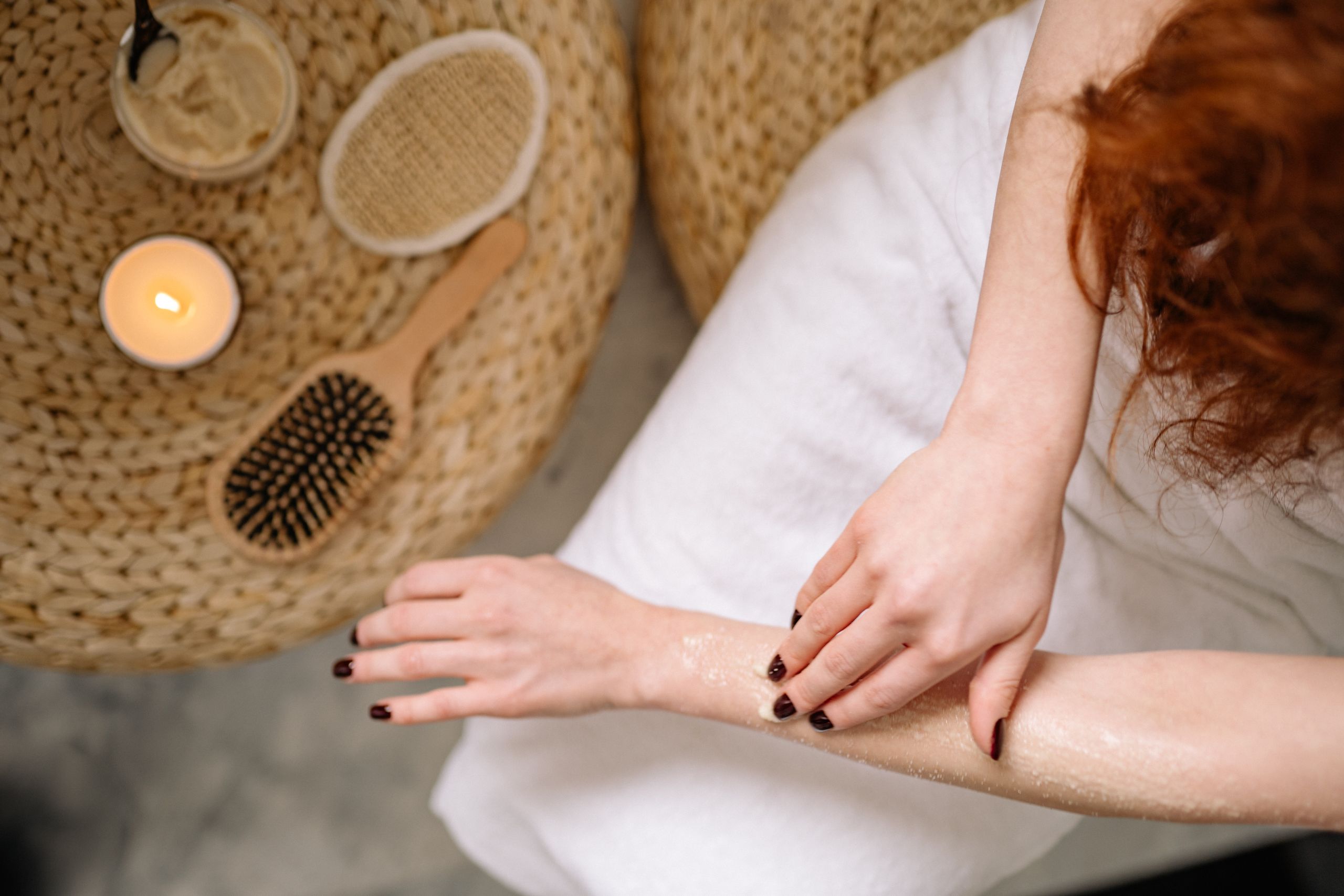
An exfoliating mitt is the most practical option for spray tan prep. It works through physical friction, no product involved, so there is zero residue to worry about. Use it with water and a mild, oil-free wash if you want, or dry. Circular motions, moderate pressure, extra time on rough zones: elbows, knees, ankles, tops of feet.
If you want a scrub, look for one with fine physical exfoliants and no oils. Most sugar scrubs contain carrier oils and leave residue even after a full rinse. Check the ingredients. Coconut oil, sweet almond oil, shea butter near the top of the list means that scrub is not for spray tan prep.
Work lightly on your face
Facial skin is thinner and responds differently to friction than body skin. If you plan to include your face in the spray tan, use a gentle face scrub or a soft cloth rather than the same mitt you used on your legs. Too much exfoliation on the face can leave the surface more reactive and change how it develops relative to your body.
What not to use when exfoliating for a spray tan
Oil-based scrubs are the most common mistake. They feel like they rinse clean, but they do not. The film stays. Beyond oil, the other category to drop before a spray tan appointment is chemical exfoliants.
AHAs (glycolic acid, lactic acid) and BHAs (salicylic acid) accelerate cell turnover. Use them the night before and your skin surface is mid-shed when the DHA lands. Color binds to cells already on their way out, and the tan fades unevenly within the first few days. Stop chemical exfoliants two to three days before your session.
Retinol is the same situation. It speeds up the turnover cycle, and using it in the days before your appointment means a less stable surface for the DHA to bind to. If you use retinol regularly, stop three days out. The color will hold longer on skin that is not mid-cycle.
Problem zones: where skipping exfoliation shows up first
Some areas build up dead cells faster than others, mostly because of friction or persistent dryness. These are the spots where inadequate prep shows up most clearly in the finished tan.
| Zone | Why it grabs more color | What to do |
|---|---|---|
| Elbows | Thick, layered skin with high texture accumulates more DHA contact points | Spend extra time with the mitt in circular motions; use light pressure |
| Knees | Folded skin texture holds buildup in the creases | Exfoliate with the knee slightly bent so the mitt reaches into the folds |
| Ankles and heels | High-friction zones with dense, dry texture | Focus the mitt here longer than on the lower leg |
| Wrists | Finer skin that can still grab color unevenly without prep | Light pass with the mitt, circular motion |
| Tops of feet | Dry skin that darkens fast, especially around toe creases | Exfoliate, then apply a thin layer of unscented lotion right before the appointment |
Feet are the one exception to the arrive-product-free rule. A small amount of unscented, oil-free moisturizer on the tops of your feet and between the toes right before the session reduces over-development in those dry creases. Your technician can confirm whether they recommend it for your skin type.
The day of your appointment: what to do after exfoliating
After exfoliating the night before, shower with a mild sulfate-free wash and put nothing on after. Keep the surface clean and product-free until you walk in. The full spray tan prep checklist covers what to avoid on the morning of, what to wear, and how to handle the hours after your session.
What happens when you skip exfoliation
Skipping does not automatically ruin the result, but the pattern is predictable. Dry zones develop darker. Elbows and knees go patchy within the first few days as the uneven buildup sheds at different rates. The overall color fades faster because it is sitting on a surface that was already partway through its natural cycle.
The technician sprays the same pass regardless. Patchy elbows, dark ankles, fading that starts at day three instead of day seven: all of it traces back to what the skin surface looked like when the solution landed. Exfoliating for a spray tan the right way is the most direct mechanical input you have on the color you walk out with.
Once the tan develops, keeping the color longer is its own set of steps. But it starts with the surface you prepared the night before.
GlowDrop Review: Do Drinkable Tanning Drops Actually Work?
Self-Tanner on Tattoos: How It Changes the Look of Healed Ink
How to Self-Tan Hands Without Orange Knuckles
Cyklar Self-Tanning Milky Essence Review: Who Is It For?
Melanotan II vs DHA Self-Tanner: What the Barbie Peptide Gets Wrong
Can You Use Retinol With Self Tanner? A Night-by-Night Schedule