
Self Tanner Undertones: Why the Same Product Looks Different on You
If you’ve ever used a self tanner that looked perfect on someone else but turned slightly orange on you, it wasn’t random. Most people blame the product. Or assume they applied it wrong. Some just write off self tanner entirely and stop trying.
I did the same for a long time. Kept switching brands thinking I just hadn’t found the right one yet. In most cases, none of that is the actual problem.
Self tanner doesn’t cover your skin tone. It reacts with it. The color you end up with is the formula interacting with what’s already in your skin, and depending on what’s there, that interaction pushes the result in different directions. Two people using the same product, same technique, same development time, and they walk away with genuinely different results. That’s not inconsistency in the product. It’s just how the reaction works.
Once you see it this way, a lot of past results suddenly make sense.
The Part Most Self Tanner Guides Never Explain Properly
Every self tanner relies on an active ingredient that reacts with the outermost layer of your skin to produce color. It doesn’t sit on top, and it doesn’t replace anything. It reacts with what’s there.
That’s why the same formula produces different shades on different people. The base tone of your skin, not the surface shade but the underlying color you were born with, changes how the reaction reads once it develops. A formula that produces a clean golden finish on one person produces something warmer, more orange on another, because the ingredients are reacting with a different starting point.
The color you see is not just the formula. It’s the formula meeting what’s already there.
That’s the part most guides skip. They treat self tanner like paint you apply to a white wall. It’s closer to a stain you apply to wood, where the grain underneath still shows through.
Why Self Tanner Looks Orange on Some People and Not Others
The undertone of your skin is the base color that sits beneath the surface. It doesn’t really change with your tan or the season. It’s always there, and it always interacts with whatever you put on top.
When someone with a pink or reddish base uses a formula built around warm, brown tones, those two color signals add together. The formula was already pushing warm. The skin underneath is pushing warm. The result tips past golden and into orange. It’s not random. It’s a predictable combination.
This is usually the point where it clicks. Not every self tanner is bad. It just wasn’t built for your base.
That’s why the same product that looks great on a friend with olive or golden-toned skin looks off on someone with cooler, pinker undertones. Neither person applied it wrong. They just have different starting points, and the formula didn’t account for that difference.
When this happens after application it’s a mismatch problem, not a technique problem. The post on why self tanner turns orange covers what to do when it’s already happened. This article is about avoiding it before you buy.
How to Find Your Skin Undertone for Self Tanner
You’re not trying to label yourself perfectly. You’re just trying to avoid the wrong category.
There are three rough signals that most people can read accurately without any special knowledge.
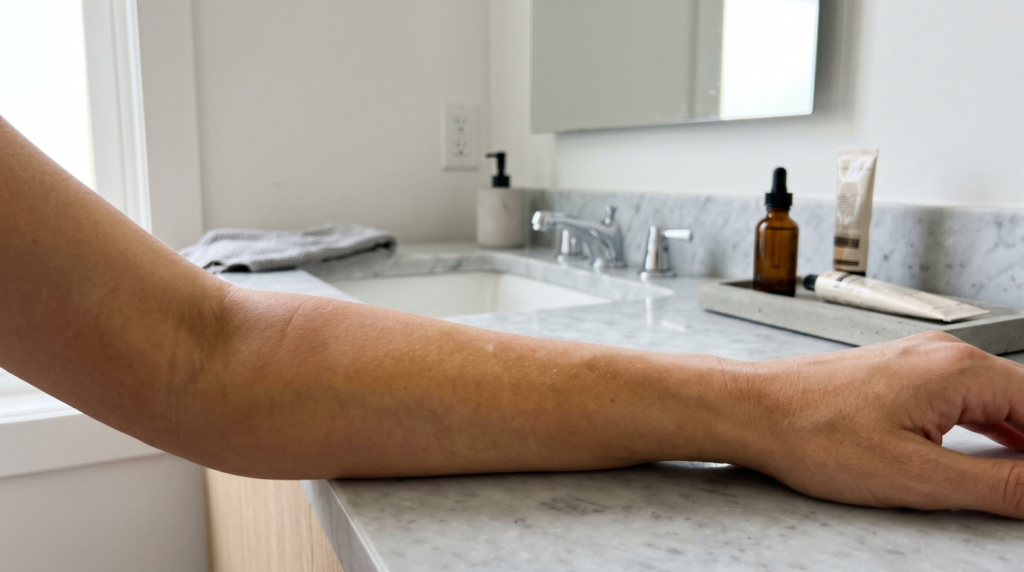
The vein test is the most reliable one. Look at the inside of your wrist in natural light. Veins that read more blue or purple point to cool undertones. Veins that read more green point to warm undertones. If you genuinely can’t tell and you’re seeing both, you’re probably neutral.
Sun reaction gives a secondary read. Skin that tends to go pink before it goes golden, or that burns more than it tans, usually has cool undertones. Skin that picks up color quickly and skips the red stage tends to run warm.
Metal preference is less reliable as a standalone signal, but useful as a tiebreaker. Silver tends to look better on cool undertones, gold on warm. If you’ve never thought about it and genuinely can’t tell, you’re likely neutral.
None of these tests give you a perfect read. They don’t need to. You just need to know whether you’re closer to cool, closer to warm, or somewhere in between. Once you have that, you can pick the right formula direction before anything touches your skin, which matters more than any prep step. That said, how your skin is prepped on the day still affects how evenly the formula develops, and preparing skin for self tanning covers what actually makes a difference there.
Cool undertones: pink, red, or blue tones in the base
Cool-toned skin has more pink, red, or blue in the base. It often sits in fair to light ranges, though not always. Medium and deeper skin tones can also run cool.
This is where most “self tanner turns orange on me” cases come from.
Standard brown-based formulas push warm by default. On a warm or neutral base, that reads as golden. On a cool base that’s already contributing red or pink, that same formula reads as orange. The more contrast between your natural base and the formula’s direction, the more obvious the shift.
Fair skin with cool undertones has the least margin here. With less existing pigment, the mismatch has nowhere to hide.
Warm undertones: golden, yellow, or peachy base
Warm-toned skin tends to run golden, peachy, or yellow in the base. Most standard self tanner formulas are built with this base in mind, which is why warm-toned people generally have an easier time finding formulas that work.
The main thing to watch for here is DHA concentration relative to your skin depth. A very fair person with warm undertones using a formula with high DHA can still tip into an artificial caramel that doesn’t read as natural. The undertone is right, but the intensity isn’t calibrated to the amount of pigment in the skin. Buildable formulas work better here than jumping straight to a dark shade.
Neutral undertones: where either works, but inconsistency is real
Neutral undertones don’t lean clearly warm or cool. The base has elements of both, which means a wider range of formulas can work without obvious mismatch.
What people with neutral undertones often notice, though, is inconsistency. One product looks great, the next one from the same brand looks slightly off, and there’s no obvious reason why. With warm undertones the correction is predictable, but cool undertones the need is clear. With neutral there’s no single corrector that’s always the answer. Results depend more on DHA concentration and formula quality than on color base matching.
That’s why one product can look great and the next one slightly off, even if nothing else changed.
This is where people start thinking they’re applying it wrong when they’re not.
Green, Violet, and Brown Base: What These Actually Correct
These aren’t marketing labels. They’re corrections for predictable shifts.
Green base works on the principle of color opposition. Green sits opposite red on the color wheel, which means it cancels red and pink tones rather than amplifying them. A green-tinted formula doesn’t turn you green. The guide color washes off. What it does is neutralize the reddish base in cool-toned skin during development, so the final result reads golden instead of orange. Best match: cool undertones, especially fair to light skin with visible pink or red tones.
Violet base does something similar but targets yellow. Violet cancels yellow and warm tones, producing a cooler, deeper finish. It reads as more olive or chocolate rather than golden caramel. Works well for warm or neutral skin that wants a less sun-kissed, more dimensional result. Not the right pick for cool undertones that are already running low on warmth.
Brown base is the default. No correction built in. Works cleanly on warm and neutral undertones because the formula direction and the skin’s natural base are pointing the same way. On cool undertones it tends to tip orange for the same reason: nothing is counteracting the warm push.
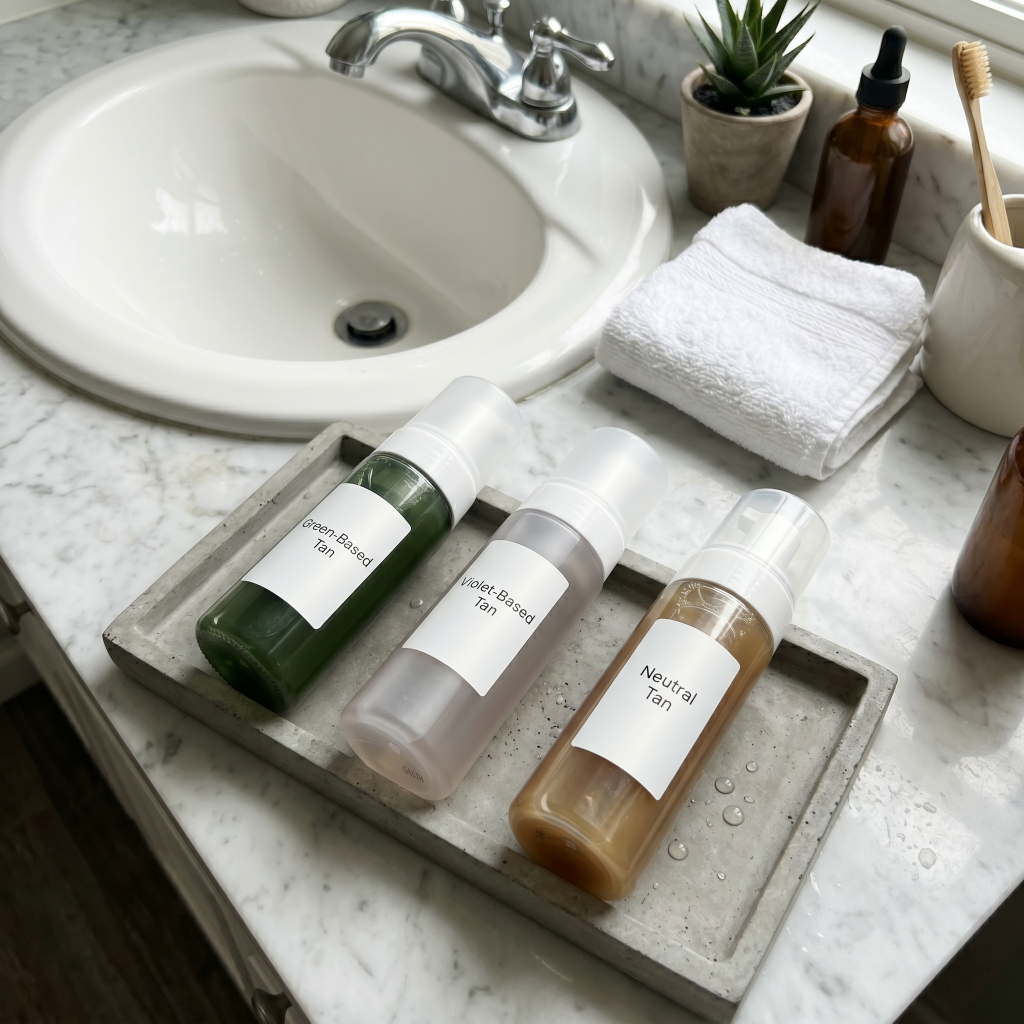
Most formulas at drugstores and mass retailers are brown-based. That’s why cool-toned people have historically struggled more with self tanner than warm-toned people, and why the jump to a green or violet base often feels like a revelation the first time.
Why Fair Skin Shows Undertone Mismatches More
There’s less margin for error.
On deeper skin tones, the existing pigment volume absorbs some of the mismatch. A formula that’s slightly off in the wrong direction still produces something plausible because the natural color base is strong enough to moderate the result.
On fair or very fair skin, there’s far less baseline pigment to buffer against. Whatever the formula does, it reads clearly against that pale starting point. A small mismatch in base color that would be invisible on medium or deep skin shows up immediately on light skin.
That’s a big part of why fair-skinned people are more likely to have had bad experiences with self tanner. The product did what it was designed to do, it just wasn’t designed with their starting point in mind. The fix isn’t a different technique. It’s a formula with a base that accounts for a cooler, lower-pigment starting point.
That’s why fair skin tends to get the worst results with the wrong formula, but also the best results with the right one.
More detail on which specific formulas work for pale skin is in the best self tanner for pale skin breakdown.
What to Choose Based on Your Undertone
A quick reference before the details get in the way.
Cool undertones (pink, red, blue base): green-based or violet-based formula. Avoid standard brown-based formulas, especially in medium or dark shades.
Warm undertones (golden, yellow, peachy base): brown-based formula works well. Match the DHA concentration to your skin depth. Lighter skin still needs a lighter or buildable formula even if the base direction is right.
Neutral undertones (no clear lean either way): brown-based is a safe starting point. If results have been inconsistent, try a formula with a violet base before assuming the undertone read was wrong. Concentration matters more here than correction.
Getting the base direction right is the first call. Once that’s settled, how to apply self tanner correctly covers the application side so the formula actually develops the way it should.
What People Get Wrong About Self Tanner and Undertones
It usually comes down to undertone. If your skin has more pink or red underneath and theirs leans more golden or olive, the same formula is going to develop differently. It’s not that the product is inconsistent. It’s that it’s reacting to two different starting points.
If your skin is fair and leans cool or pink, then yes, it usually makes a noticeable difference. If your skin is fair but warm, it can actually look slightly off. It’s less about how light your skin is and more about the direction your undertone is pulling.
You can, but it will usually come out warmer than you expect, sometimes noticeably so. If you’ve tried it before and liked the result, your undertone might be closer to neutral. If it keeps turning orange, the formula is working against your base rather than with it.
Both matter, but not in the same way. Undertone decides whether the result looks natural or slightly off. Shade just controls how deep the color goes. You can fix a shade that’s too light by building it up, but you can’t really fix a base that doesn’t match you.
You don’t need to get it perfect. Look at your veins in natural light, notice how your skin reacts in the sun, and pay attention to whether gold or silver tends to suit you better. If you’re roughly in the right category, that’s enough to make a better choice.
GlowDrop Review: Do Drinkable Tanning Drops Actually Work?
Self-Tanner on Tattoos: How It Changes the Look of Healed Ink
How to Self-Tan Hands Without Orange Knuckles
Cyklar Self-Tanning Milky Essence Review: Who Is It For?
Melanotan II vs DHA Self-Tanner: What the Barbie Peptide Gets Wrong
Can You Use Retinol With Self Tanner? A Night-by-Night Schedule