
How to Tan Faster and Darker Outside: The Variables That Change Your Results
Most guides on this topic give you a list. Exfoliate. Use oil. Rotate positions. Eat carrots.
Fine. But none of them tell you which ones actually move the needle and which ones are just padding. And none of them explain that doing the wrong things in the wrong order can actively make your tan slower, not faster.
After years of tanning consistently, I can tell you: there are maybe three variables that genuinely change how dark you get and how fast you get there. Everything else is marginal. If those three are off, no amount of beta-carotene is going to fix it.
Short answer: To tan faster and darker outside, focus on three variables: timing, skin prep, and tanning oil. When those are in place, each session produces more color without needing more time in the sun.
What makes the biggest difference
- Timing (when you tan)
- Skin prep (before the session)
- Tanning oil (how much UV reaches your skin)
What matters less than you think
- Staying longer in the sun
- Diet changes
- Minor positioning tweaks
The one thing nobody tells you about tanning faster. Once you understand this, everything else starts to make sense
More time outside does not mean more color.
I know that sounds wrong. But once your skin has produced what it can for the day, additional UV doesn’t stack. It just stresses the surface. The result isn’t a deeper tan. It’s redness, peeling, and three days of recovery where you can’t tan at all.
The people who build the deepest tans quickly are almost always doing shorter sessions than you’d expect. 35 minutes, maybe 45. Done. They’re not trying to get the whole week’s worth of color in one afternoon.
Once that clicked for me, everything changed. I stopped thinking about maximizing time and started thinking about maximizing output per minute.
Timing is the variable most people get completely wrong
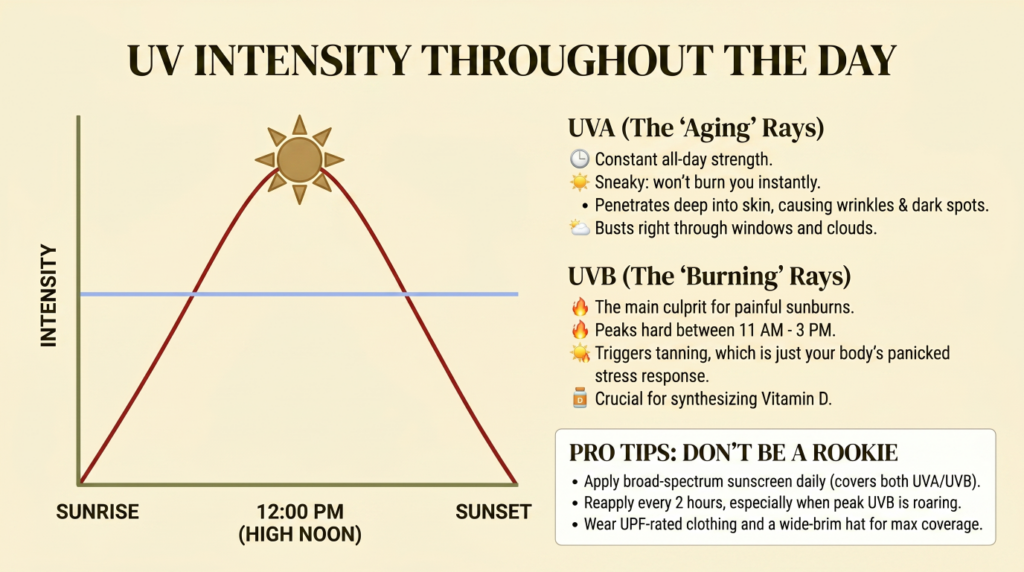
Here’s something the generic guides skip: a 40-minute session at 9am and a 40-minute session at 2pm are not the same thing. This single variable can outperform any product you use.
UV intensity follows a curve through the day. It builds toward a peak around solar noon, then drops off. At 2pm, you’re already on the downside of that curve. The sun still feels warm. It might even feel hot. But the UV that triggers melanin production, the UVA and UVB that actually cause color, has fallen significantly.
I spent two full summers tanning in the early afternoon because that’s when I had time. I was getting some color, but it felt slow and inconsistent. Then, I moved my sessions to 9-10am and kept everything else the same. The difference in two weeks was enough that people commented on it.
The sweet spot for most skin types is UV index between 3 and 5, before 11am. That’s the window where the UV is doing real work without being so intense that fair skin tips toward redness instead of color. One session in that window outperforms two sessions in the afternoon. Every time.
The best time of day to tan and best UV index for tanning cover the detail on how to read conditions before you head out.
Why your prep is silently killing your tan. This is why some tans fade before they ever build.
Here’s the one that gets me every time I tell someone and they’ve never thought about it.
The tan develops in the outermost layer of your skin. Those cells have a lifespan of a few days before they shed and get replaced by the cells underneath. If you tan without exfoliating first, the color deposits in cells that are already close to the end of that cycle. Two or three days later, those cells shed. Your tan goes with them.
You built color on a surface that was already leaving.
Exfoliating 24 to 48 hours before a session removes that layer and exposes the newer cells underneath. A tan built on those cells lasts significantly longer because those cells have their full lifespan ahead of them. The depth of color you develop is also better because the UV is hitting a cleaner, more receptive surface.
This is why some people’s tans seem to hold for two weeks while others fade in three days. It’s almost never skin type. It’s almost always this.
The exfoliate before tanning article covers the exact timing and how to avoid making the skin reactive before a session.
Hydration works on the same principle. Dry surface cells shed faster. If you’re moisturizing consistently between sessions you’re extending the lifespan of the cells holding your color. The moisturizing for tanning guide explains which formulas support color retention and which ones don’t.
Tanning oil: what it actually does and when it matters. This is where everything starts to compound
Once timing and prep are right, this is where depth gets added.
The oil creates a layer on the skin surface that concentrates UV instead of letting it scatter. More UV per square centimeter, in the same window of time, without extending the session. If you have a good accelerator with tyrosine or beta-carotene, it’s also priming the melanin production process before UV even arrives.
The compounding effect is real. Prepped surface absorbs better. Correctly timed UV is efficient, not excessive. Oil maximizes what that UV does per minute. The three together produce results that none of them would produce alone.
Here’s what I noticed the first summer I ran all three properly: by week two I had more color than I’d usually have at the end of a full month. Not because I was outside more. I was outside less. The sessions were shorter, earlier, and more deliberate.
The detail on how oil actually works and which products produce the most visible difference is in does oil make you tan faster and the best tanning oil for a dark tan ranking.
The things that genuinely help (and how much)
Rotation. Every 20 to 30 minutes, change position. Back, side, front, other side. The zones that sit in partial shade during a session, the sides of the body, the upper arms, the collarbone area, are the reason tans look patchy or flat rather than deep and even. This doesn’t make color develop faster. It makes it distribute properly. Two different things, both worth doing.
Reflective surfaces. Sand and water both bounce UV back at the skin from angles that a flat garden surface doesn’t. This is part of why beach tans develop faster than equivalent time at home, even when the UV index is similar. Not something you can manufacture, but worth knowing if you’re choosing between locations.
Consistency over intensity. Three 35-minute sessions in a week builds a better base than one 90-minute session. The color from the first session develops fully before the second adds to it. The base that forms over two weeks of consistent short sessions is deeper and more stable than anything you can get from occasional marathon days.
What the internet keeps telling you that doesn’t work
Beta-carotene supplements and eating carrots. This comes up in every guide. Beta-carotene gives the skin a very slight warm tint over time and may marginally reduce sensitivity to UV. It does not accelerate melanin production the way UV does. It is not a tanning strategy. It’s a nice thing to eat.
Staying out longer. Already covered at the top, but it’s worth repeating because it’s the most common mistake. If your sessions are regularly producing redness or making your skin tight, you’ve gone past the productive window. More time won’t fix that. Shorter sessions at a better time of day will.
Salt water sprays. Real sea water at the beach does marginally amplify UV absorption and provides light exfoliation. A salt water spray you make at home does almost none of that because sea water contains minerals beyond just salt that drive most of the effect. It’s not worth building a strategy around.
If you’re doing all of the above and still not seeing color, the problem is upstream from all of this. The why am I not getting tan article covers what’s actually blocking results when nothing seems to work.
What a session that actually produces depth looks like
Night before: exfoliate, moisturize. Both done. Not optional. The goal is to stop while your skin is still inside its productive window, not when you feel like you’ve had enough sun.
Morning of: oil applied at home before leaving. Not at the beach. At home, with time to absorb before UV exposure begins. If you’re using SPF, that goes on first, then oil on top after it sets.
Outside: 35 to 45 minutes in the right UV window. UV index checked on a weather app before heading out. Rotation every 20 minutes to cover all angles.
After: no hot shower. Moisturize before fully drying. That’s it.
Four things. None of them complicated. All of them consistently producing more color per session than any amount of extra time in the sun.
One thing outdoor sessions almost always leave behind: tan lines from socks, straps, or a hat. They tend to be sharp and do not blend out on their own for weeks. If you pick one up, this is the fastest way to fix a tan line without waiting for it to fade naturally.
The how to tan faster guide covers the broader context around building and holding a base across the season.
What to know before trying to tan faster
With timing, prep, and oil in order, most people with some existing base see visible deepening within 4 to 6 sessions. Starting completely fresh adds a week or two before the base exists to build on. The color from each session develops in the 24 to 48 hours after, not immediately, so judging the result the same evening always underestimates what actually happened.
Evenly, primarily. Rotation distributes UV to zones that otherwise sit in partial shade, which prevents the patchy, uneven result of tanning in one position. It doesn’t change how deep the color gets per zone. For speed and depth, timing and prep do more. For the result looking natural rather than flat, rotation is what makes the difference.
Yes, significantly. Late morning UV sits in the productive range for most skin types: enough to generate real color per session, not so intense that fair skin tips toward redness. Afternoon sun past 2pm drops off in tanning effectiveness while still feeling hot. The sensation of heat and the UV dose that produces color are not the same thing.
With a proper setup, 5 to 7 sessions builds a visible base. A genuinely deep tan typically takes 10 to 15 consistent sessions. Trying to compress that into fewer longer sessions usually resets progress rather than accelerating it, because redness and peeling cancel what previous sessions built.
Slightly. Water on the skin surface creates some UV reflection, similar to how pool water reflects UV toward you. The effect is real but modest. The more impactful hydration variable is internal: well-moisturized skin holds color longer because surface cells stay intact longer before shedding. Dunking yourself in water before tanning is not a meaningful shortcut.
If what you want is a full session-by-session outdoor routine with exact timing, prep, and aftercare built in, the outdoor tanning routine covers exactly that.
Peta Jane Self Tanner Review: Does the Allure-Winning Mousse Actually Deliver?
GlowDrop Review: Do Drinkable Tanning Drops Actually Work?
Self-Tanner on Tattoos: How It Changes the Look of Healed Ink
How to Self-Tan Hands Without Orange Knuckles
Cyklar Self-Tanning Milky Essence Review: Who Is It For?
Melanotan II vs DHA Self-Tanner: What the Barbie Peptide Gets Wrong