
Can You Tan with Sunscreen On? Here’s What Actually Happens
Yes, you can tan with sunscreen on, or sunblock, same thing. No sunscreen blocks 100% of UV rays, so some amount always gets through, hits your melanin cells, and starts the tanning process. The question is how much sunscreen slows that down, and whether the tradeoff makes sense for what you’re trying to do.
I spent a long time treating sunscreen and tanning as opposites. Wear SPF and stay pale, skip it and go darker. That’s not how it works. The actual mechanism is more interesting, and once you understand it, you can make smarter decisions about when to wear what.
Yes. SPF 30 blocks about 97% of UVB rays and SPF 50 blocks about 98% (American Academy of Dermatology), meaning UV still reaches your skin, triggers melanin production, and produces a tan. Sunscreen slows the process but does not stop it. With SPF 30, tanning takes roughly 3x longer than with no protection.
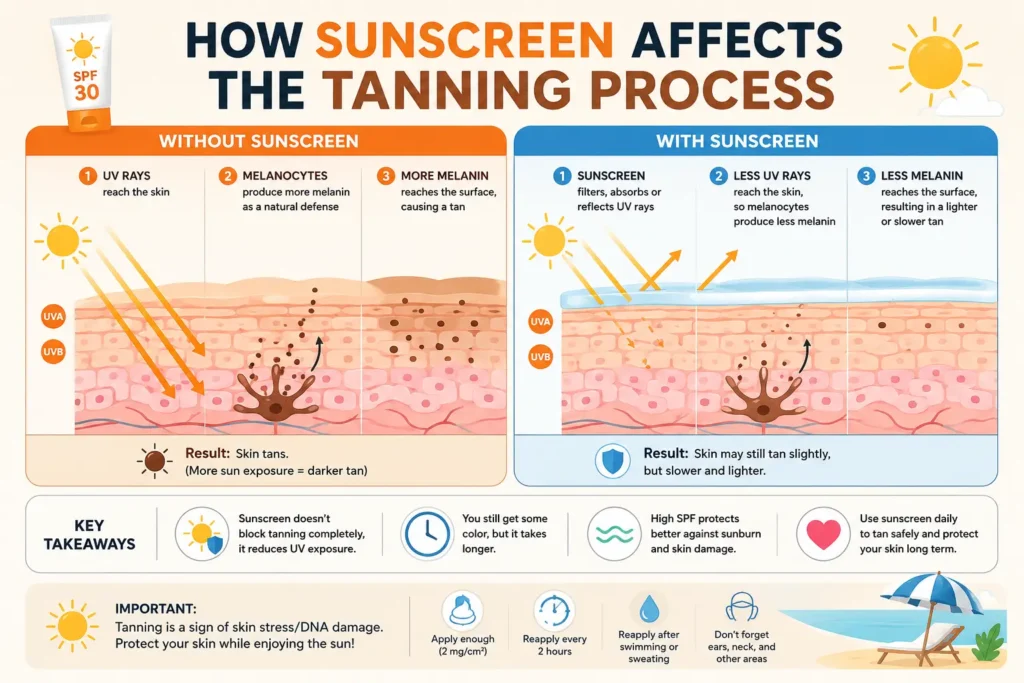
How sunscreen affects the tanning process
Tanning happens when UVA rays penetrate deep into your skin and activate melanocytes, the cells that produce melanin. UVB rays are the ones responsible for burning. Most sunscreens, especially broad-spectrum formulas, filter both. But filter doesn’t mean block completely. It means reduce.
SPF is a measure of how long you can stay in the sun before burning, relative to unprotected skin. SPF 30 means it would take 30 times longer to burn with the product on than without. As a side effect of that burn protection, the UV getting through is also lower, which slows the tan. But lower UV still means some UV, and some UV still means some tan.
The part that trips people up is UVA specifically. Some older or cheaper sunscreens are labeled high SPF but aren’t true broad-spectrum. They block UVB well but let a lot of UVA through. With those, you can tan without burning, which sounds great until you realize UVA is also what drives photoaging. Broad-spectrum is always the smarter label to look for, even if you’re actively trying to tan.
Can you tan with SPF 30? What about SPF 50?
Yes to both. The difference between them is smaller than most people expect.
SPF 30 lets through approximately 3% of UVB rays. SPF 50 lets through approximately 2%. That 1% difference sounds tiny, but over a full day outside it compounds. If you spend four or five hours in the sun, SPF 50 gives you meaningfully more protection than SPF 30, even though neither is a wall. For tanning purposes, both still produce color. SPF 50 just produces it a bit more slowly.
SPF 15 lets through about 6-7% of UV rays. You’ll tan faster with SPF 15 than SPF 30, but your burn threshold drops significantly. If your skin is fair or you’re somewhere with a high UV index, SPF 15 is where things get risky before you see much payoff in terms of deeper color.
How much slower do you tan with sunscreen? As a rough estimate: SPF 30 lets through about 3% of UV versus 100% with no protection, so tanning takes approximately 30x longer per unit of UV. In practice that means sessions need to be longer or more frequent to build the same color, not that tanning stops entirely.
| SPF | UV rays blocked | UV rays that get through | Tanning pace | Burn risk |
|---|---|---|---|---|
| SPF 15 | ~93% | ~7% | Fastest with SPF | Moderate, burn threshold lower |
| SPF 30 | ~97% | ~3% | Moderate | Low, good balance for most skin |
| SPF 50 | ~98% | ~2% | Slower | Very low, best for fair or sensitive skin |
| No sunscreen | 0% | 100% | Fastest overall | High, burn risk rises quickly |
If you want to tan with sunscreen on, SPF 30 broad-spectrum is where most people land. Enough protection to stay out longer without burning, and enough UV getting through to build real color across multiple sessions. Higher SPF doesn’t prevent tanning, it just slows the pace.
Tanning with sunscreen vs without: what’s the actual difference
Without sunscreen, you’re working with 100% of whatever UV is hitting you. You tan faster and you burn faster. Whether that’s worth it depends on your skin type, the UV index, and how long you’re outside.
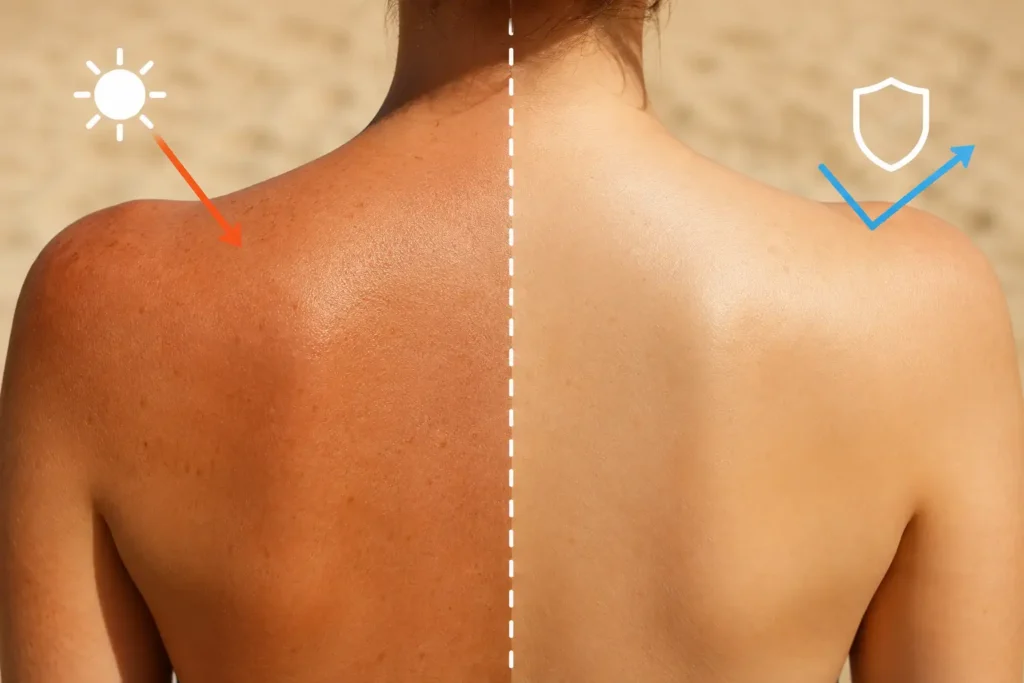
With sunscreen, both processes slow down. You burn later, which means you can stay outside longer before your skin hits its limit. In practice, a lot of people get more total UV exposure with sunscreen on, because they stay out for three hours instead of one before their skin starts to react. The color that builds that way tends to be more even and last longer than a fast burn-and-peel session without SPF.
I started wearing SPF 30 consistently a few summers ago after burning badly twice in the same season and losing weeks of color both times. The tan I built that summer wearing sunscreen every session lasted longer than anything I’d gotten the years before by going unprotected. Not deeper necessarily, but it held. Skin that burns and peels doesn’t hold a tan. It sheds. Sunscreen keeps the base you built intact.
How long does it take to tan with SPF 50?
There’s no single answer because UV index, skin tone, time of day, and cloud cover all change the math. As a rough frame: if unprotected skin would start showing color in 20 minutes at a UV index of 7, SPF 50 skin is working with about 2% of that UV load. The biological process still happens, just slower. Expect visible color after multiple sessions, not one.
UV index is more useful to track than clock time. UV index 3 at 10am is a completely different exposure than UV index 9 at noon, even if you’re outside for the same number of minutes. Tanning with SPF 50 works best at higher UV index windows, where enough rays get through SPF’s filter to actually do something. At UV index 2 in the late afternoon, you can spend two hours outside and come back with nothing.
What sunscreen won’t do
It won’t stop tanning entirely. It won’t give you color faster. Applying it unevenly is how you end up patchy, because the spots you missed tan faster and the covered areas lag behind.
Sunscreen also degrades. After about two hours, especially if you’ve been in water or sweating, SPF protection drops. Reapplying keeps protection consistent and keeps the tan building at an even rate across your skin. Skipping reapplication doesn’t speed up your tan in any useful way. It just makes UV exposure unpredictable.
- You can tan with sunscreen on because no SPF blocks 100% of UV rays.
- SPF 30 lets through ~3% of UVB; SPF 50 lets through ~2%. Both produce gradual color.
- Tanning with SPF takes longer but produces more even color that doesn’t peel after burning.
- Reapply every two hours. Sunscreen degrades and uneven protection creates patchy results.
- UV index matters more than clock time. Sessions at UV index 3 or below rarely produce visible color even without sunscreen.
How to actually get more color while wearing sunscreen
Time it to peak UV hours. Between 10am and 2pm, UV index is at its highest in most of the US during summer. That’s when the UV getting through SPF actually adds up to something. Early morning or late afternoon sessions with SPF 30 often produce no real color because there isn’t enough UV to work with after the filter.
Positioning matters too. Reflective surfaces like sand or water increase how much UV reaches your skin. On a beach at noon with SPF 30, you’re getting meaningful UV. On a shaded patio with SPF 50, probably not. In the second scenario, the sunscreen isn’t the limiting factor. The environment is.
If you want to speed things up without going lower on SPF, tanning accelerators work differently from sunscreen. They don’t increase UV exposure. What they do is prime the skin to respond more efficiently to the UV it does receive. And if you’re wondering whether tanning oil actually makes you tan faster, the mechanism is similar but not identical.
On sunscreen itself: for tanning sessions I lean toward formulas that go on light and don’t leave a white cast, since you’re reapplying every two hours and a heavy formula makes that annoying. La Roche-Posay Anthelios and EltaMD UV Sport are the two I come back to. Both broad-spectrum, both absorb cleanly, and neither interferes with how an accelerator sits on top.
The other lever is session length. With sunscreen on, your burn threshold is extended, which means you can stay outside longer before your skin signals it’s had enough. Spreading that exposure across more hours at a consistent UV index builds more even color than short unprotected sessions followed by recovery days. If you want to go further, there are specific variables that actually change how fast you tan beyond just time in the sun.
Wearing sunscreen doesn’t mean giving up on a tan. It means building one more slowly and keeping it intact instead of peeling it off. SPF 30 at peak UV hours produces real color over time. The people who tan well with sunscreen on are usually consistent across multiple sessions, not the ones who skip SPF and start over after burning. For what it’s worth, I wear sunscreen on my face and chest every single session regardless of what I’m trying to do with the rest of my body. Some things aren’t worth trading.
GlowDrop Review: Do Drinkable Tanning Drops Actually Work?
Self-Tanner on Tattoos: How It Changes the Look of Healed Ink
How to Self-Tan Hands Without Orange Knuckles
Cyklar Self-Tanning Milky Essence Review: Who Is It For?
Melanotan II vs DHA Self-Tanner: What the Barbie Peptide Gets Wrong
Can You Use Retinol With Self Tanner? A Night-by-Night Schedule