
What Does a Browning Lotion Do: How It Works and When It Makes Sense
You see it at the beach, at Target, and on every Hawaiian tanning shelf. Browning lotion sits next to tanning oil and regular sunscreen, looks similar to all three, and the label doesn’t explain much. People either assume it’s a self-tanner (it’s not), or they grab it thinking it’s sunscreen (also not), or they’ve heard it works from someone who swears by it and buy it without fully understanding why.
Here’s the short version before the detail: browning lotion is a tanning accelerator. It works with your skin’s natural melanin production to help you build color faster during UV exposure, whether that’s outdoors in the sun or in a tanning bed. It doesn’t color your skin on its own. Without UV, nothing happens.
What a Browning Lotion Does to Your Tan
Your skin produces melanin when it detects UV radiation. Melanin is the pigment that darkens your tone and creates visible color. The speed of that process depends partly on your skin type and partly on how prepared your skin is to respond.
Browning lotion works by supporting and accelerating that melanin response. The key ingredient in most formulas is tyrosine, an amino acid that acts as a building block in the melanin production chain. By delivering extra tyrosine to the surface of the skin before UV exposure, the lotion gives your pigment cells more of what they need to produce color faster.
Think of it like priming a surface before painting. The UV exposure is the same. What changes is how efficiently your skin responds to it.
A few additional ingredients common to browning lotions also play a role: beta-carotene can increase the skin’s melanin capacity, coffee seed oil stimulates cell metabolism at the surface, and natural plant oils keep the skin hydrated enough to absorb UV evenly. The result isn’t artificial color. It’s your own tan, developing faster and more consistently than it would on bare, unprepped skin.
Browning lotion has brown tint in the formula, which helps you see where you’ve applied it. That color transfers to towels and swimsuits. Use darker-colored items when tanning with it, or rinse quickly after contact.
Browning Lotion vs Tanning Oil: Not the Same Thing
This is the comparison people search for most, and the confusion makes sense because both products end up in the same shopping cart category.
| Browning Lotion | Tanning Oil | |
|---|---|---|
| How it works | Stimulates melanin production from within | Intensifies UV rays reaching the skin surface |
| Main mechanism | Tyrosine + botanicals accelerate pigment response | Oils concentrate and attract UV light |
| Texture | Thicker, lotion-like, more moisturizing | Lighter, oilier, faster absorbing |
| Hydration | High, conditions skin during session | Moderate, varies by formula |
| Color result | Your natural tan, faster | Deeper color from amplified UV exposure |
| Works without UV | No | No |
| Tanning bed compatible | Depends on formula (see below) | Depends on formula |
The core difference: browning lotion works on your skin’s biology, telling it to produce more melanin. Tanning oil works on physics, increasing the amount of UV that reaches your skin by creating a reflective or concentrating layer on the surface.
Both accelerate tanning. They do it through different routes. You can combine them in some routines, but they’re not interchangeable and they don’t cancel each other out.
When a Browning Lotion Makes a Real Difference
Browning lotion works best in specific conditions. It’s not magic for every situation.
When it earns its place:
You’re outdoors or in a tanning bed with a decent base already established. The melanin response that browning lotion supports is stronger when there’s already some pigment to build on. Someone with a visible base tan will get noticeably faster deepening. Someone starting completely from zero will still build color, just more gradually.
You’re using it consistently across sessions, not as a one-off. The cumulative effect of accelerated melanin production across 4 to 6 sessions produces a clearly different result than a single session with the lotion.
You have good hydration going into the session. Browning lotion works partly because it keeps the skin surface conditioned. Dry, flaky skin absorbs product unevenly and tans patchily regardless of what you apply. Exfoliating the day before and arriving with hydrated skin makes the lotion’s job easier.
When it won’t change much:
Very fair skin with zero UV history will see modest results. The melanin response needs something to accelerate. A single outdoor session with a browning lotion is unlikely to produce dramatic color on someone who hasn’t tanned in years.
Short sessions under low UV intensity. The lotion amplifies your skin’s natural response to UV. If the UV exposure is minimal, there’s less to amplify.
Can You Use a Browning Lotion in a Tanning Bed
Yes, but with one important distinction: check whether the specific formula is labeled for indoor use before you bring it into a salon.
The reason matters. Most browning lotions use mineral oil as a base. Mineral oil degrades the acrylic surface of tanning beds over time, and most salons prohibit products that contain it. If you bring in a standard outdoor browning lotion with mineral oil, you’ll either be asked to wipe it off or get charged for bed maintenance.
The workaround is simple: look for formulas specifically made for tanning bed use. Maui Babe’s Tanning Salon Formula, for example, replaces the mineral oil base with sunflower oil, which is acrylic-safe. Sun Bum also makes browning lotions in SPF versions designed for outdoor use and non-SPF versions that work in both settings.
If you’re unsure, ask the salon before your session. Most front desks know which products their beds can handle and will tell you in 30 seconds.
How to Use It for the Best Result
Application order matters more than most people think.
-
Exfoliate the day before.
Not the morning of. Freshly exfoliated skin is clean and even, which means the lotion spreads uniformly and your tan develops without patchiness. Wait 24 hours between exfoliation and your tanning session.
-
Layer SPF first for outdoor sessions.
Browning lotion has no SPF. For outdoor use, apply your SPF product and wait 10 minutes for it to absorb before layering the browning lotion on top. For tanning beds, SPF isn’t part of the routine, so skip it for indoor sessions.
-
Apply browning lotion evenly.
Use a circular motion. Work in sections rather than all at once. Use less product on elbows, knees, ankles, and the backs of hands. Those areas absorb more and can go darker than the rest if you’re heavy-handed.
-
Shake the bottle first
Most browning lotion formulas settle. A few shakes before applying ensures the active ingredients are distributed evenly throughout the product.
-
Reapply during longer sessions.
For sessions over two hours outdoors, a second pass of browning lotion keeps the formula active as the first layer absorbs.
Which Browning Lotions Are Worth Trying
A few well-established options across different use cases:
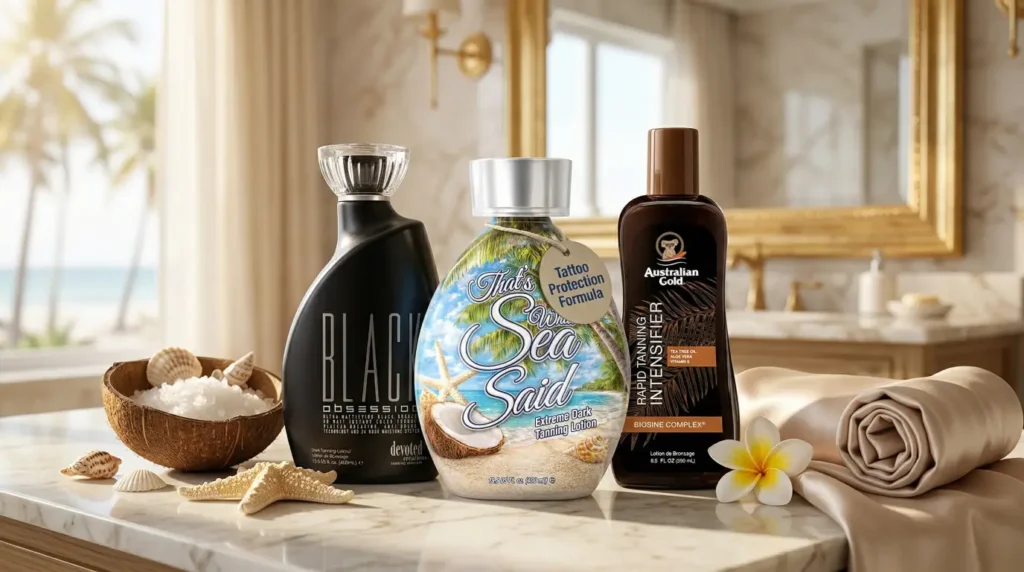
Maui Babe Original Browning Lotion is the most recognized name in the category. The formula is built around Hawaiian botanicals and Kona coffee extract. The outdoor version contains mineral oil, which means it’s not for tanning beds unless you confirm with your salon. For indoor use, the Tanning Salon Formula or the Coconut Oil variant are the right versions to reach for. The scent is strong and coffee-forward. People either love it or find it intense.
Sun Bum Browning Lotion comes in an SPF 15 version for outdoor use and a natural version without SPF. The SPF version doubles as a browning lotion and a standard outdoor product in one step. The coconut scent is mild and the formula absorbs quickly without a heavy residue.
Hawaiian Tropic Dark Tanning Oil sits in adjacent territory. It’s technically a tanning oil but uses similar botanical accelerators and is often compared directly to browning lotions for outdoor use. Works best on skin with an existing base, gives a warm, deep result.
For a ranked comparison of the top Hawaiian browning lotions side by side, the best Hawaiian browning lotion guide covers Maui Babe variants, Sun Bum, and how they compare on real results. For full session-by-session tracking of what Maui Babe does in practice, the Maui Babe before and after results piece documents the progression with honest limitations.
What It Is Not
Worth being clear because the product name creates confusion:
Browning lotion is not a self-tanner. There is no DHA in a standard browning lotion. It won’t color your skin in the absence of UV exposure. Applying it indoors and not going in the sun or a tanning bed produces no tan.
It is not a bronzer. Bronzers (used in tanning bed lotions) add immediate cosmetic pigment or trigger a DHA reaction. Browning lotion adds neither. The brown tint in the formula is a guide for application, not a colorant.
It has no SPF and no bronzing agent. For outdoor sessions, layer an SPF product underneath it as you would with any outdoor tanning product.
If you’re choosing between a browning lotion and a standard tanning oil for outdoor sessions, the comparison between what tanning oil does to your color covers how oil and lotion behave differently during the same session.
Browning Lotion Questions People Ask Most
Yes, with realistic expectations. It accelerates your skin’s natural melanin response during UV exposure, which means sessions produce more color in less time compared to going in with no product. It doesn’t create a tan by itself and it won’t turn pale skin dramatically dark in a single session. The visible difference builds across 4 to 6 consistent sessions.
Most people notice a difference after the second or third session compared to sessions without it. The first session rarely shows a dramatic change because the melanin response is cumulative. By session four or five, the depth difference between using browning lotion and not using it becomes clearly visible.
Yes. There’s no reason to limit it to occasional sessions. Using it consistently is actually what produces the clearest results. The accelerated melanin production compounds across sessions, so skipping it periodically just slows the build.
It works, but the starting point matters. Very fair skin with minimal UV history has less existing melanin to build on, so the acceleration effect is more gradual. Results are real but take more sessions to become obvious. Browning lotion with coconut oil formulas tend to work better for lighter skin tones because they’re less intense and allow color to develop more gradually without uneven patches.
Effectively yes. Browning lotion is the name used primarily by Hawaiian-style outdoor brands like Maui Babe and Sun Bum. Tanning accelerator is the term used more often in indoor tanning bed products. Both work through the same core mechanism: tyrosine and botanical ingredients that support faster melanin production during UV exposure. The main practical difference is formula concentration and whether the product is designed for outdoor or indoor use.
The brown tint in the formula transfers to fabric (towels, swimsuits, clothing) and temporarily tints your palms if you apply it with bare hands. It rinses off skin with a normal shower. The tint on fabric usually comes out in the wash, though rinsing quickly after contact gives better results. Using a tanning mitt or washing hands immediately after application avoids palm staining entirely.
GlowDrop Review: Do Drinkable Tanning Drops Actually Work?
Self-Tanner on Tattoos: How It Changes the Look of Healed Ink
How to Self-Tan Hands Without Orange Knuckles
Cyklar Self-Tanning Milky Essence Review: Who Is It For?
Melanotan II vs DHA Self-Tanner: What the Barbie Peptide Gets Wrong
Can You Use Retinol With Self Tanner? A Night-by-Night Schedule